Leak 05 · Amazon routing

Email-in to confirmed Amazon shipment, no human in the loop.

Reads Amazon's routing request emails, submits the shipment through Amazon's API, polls until Amazon confirms it, and closes out the WMS and ERP. Nobody in operations has to drive it.

The Problem

Amazon vendor compliance is strict. The workflow, from the inbound routing email all the way through final close-out, is a nine or ten step chain that someone usually has to drive by hand, every time.

The Result

An automation chain that's always on. It runs the same way at 2am as it does at 2pm, and every step gets logged.

End-to-end Amazon automation timeline: inbound email processed, shipment data extracted and validated, submitted to Amazon SP-API and tracked to confirmation, legacy systems closed automatically
  • The whole flow runs without anyone driving it, from the inbound routing email through the legacy-system close-out.
  • Amazon SP-API integration handles authentication, submission, and asynchronous transaction polling. Operations isn't babysitting tokens or refreshing status by hand.
  • The virtual operator (from Case Study 01) handles the legacy close-out steps that don't have APIs. Without it, the chain would still need someone at the end clicking through screens.
Results
0 human touches, email-in to confirmed
24/7 always-on Amazon coverage
~5 min email-to-SP-API submission
  • Fewer chargebacks. Every link that used to depend on someone doing it correctly under time pressure now runs the same way every time.
  • Room to grow Amazon volume without growing the Amazon team. Weekends and overnight stop being backlog-generating events.

Amazon is high-margin and unforgiving in equal measure.

Amazon vendor business is some of the most demanding work a 3PL can take on. The economics work because Amazon volume can be a meaningful chunk of revenue. But if you get any of it wrong, the chargebacks are automatic and you see it on the next invoice.

The flow is what gets you. A routing request comes in by email. Someone has to read it, find the shipment in the ops system, work out the cartons, group the orders, submit to Amazon's SP-API, manage OAuth tokens, and deal with the fact that submission is asynchronous — you get back a transaction ID and have to poll until Amazon makes up its mind. Once it's confirmed, you go back to the legacy systems and close out the records there. Miss any link and you eat the chargeback. For most 3PLs that means a dedicated Amazon team, careful training, a lot of knowledge living in just a few heads, and the chargebacks that happen anyway when someone's out sick or the inbox backs up over a weekend.
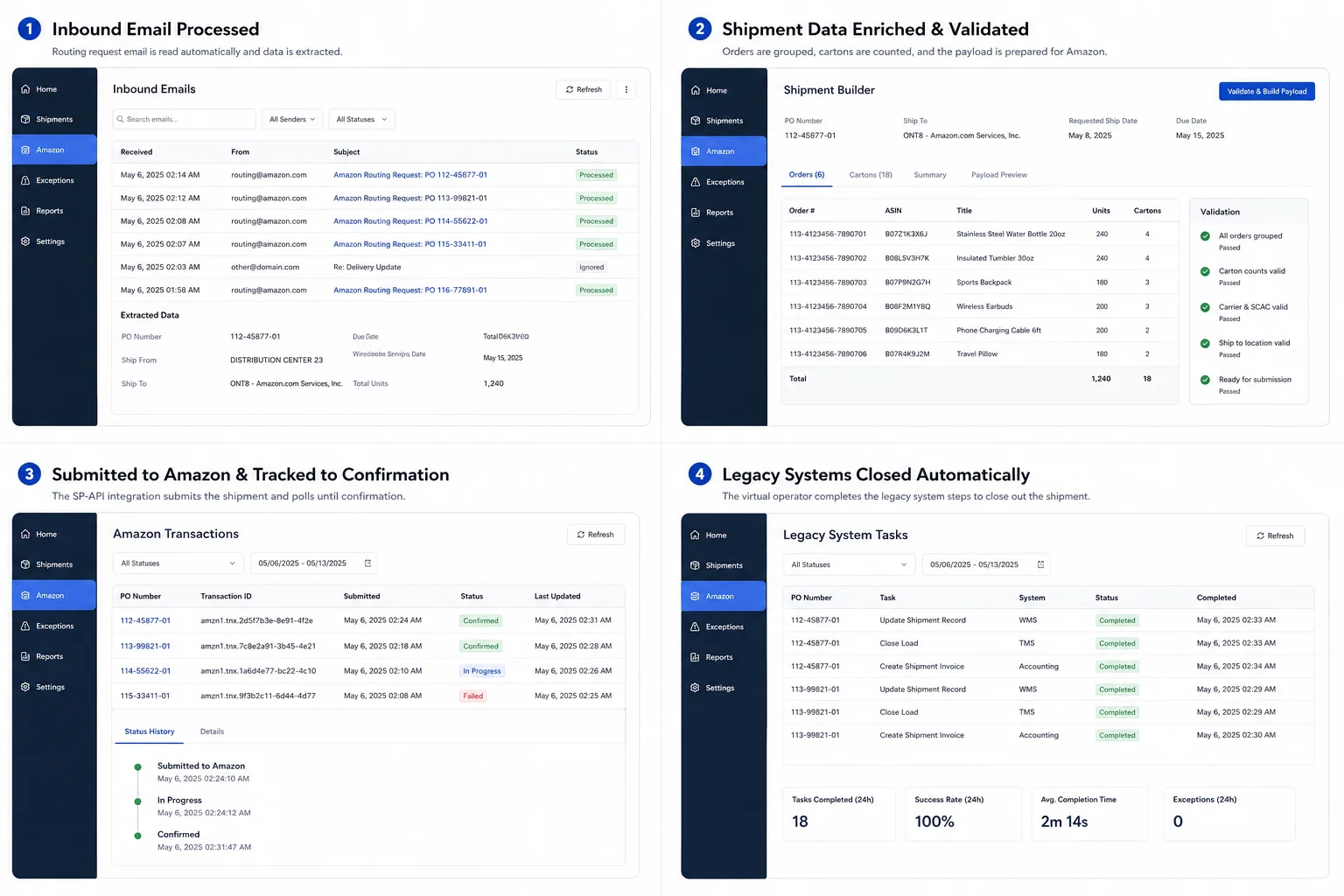
A fully orchestrated chain from inbound email to confirmed shipment.

Routing requests arrive by email and get read automatically. The shipment data is enriched and validated. The submission goes to Amazon's SP-API, and a background worker polls the transaction-status endpoint until Amazon confirms it. The virtual operator handles the legacy-system close-out at the end. The chain runs continuously, every step is logged, and operations only gets pulled in when something actually needs a human.

Four pieces that took the Amazon team off the routing-request treadmill.

Step 01

Read the inbound routing request automatically

Amazon routing requests land in the operations mailbox by email. Someone has to open each one, figure out which shipment it's about, and pull out the data Amazon will want back. A scheduled email-processing worker watches the mailbox, classifies incoming messages, and runs a specialized extractor for Amazon routing requests that pulls out the structured fields (PO numbers, dates, and the rest). The inbound side stops being an inbox-watching exercise.

Step 02

Enrich the shipment data the way Amazon expects it

Amazon's API doesn't accept whatever the operations system happens to have on file. It wants the orders grouped a particular way, validated carton counts, and shipment data shaped the way the SP-API expects. A pre-tendering manager groups the orders, runs validation (using the same rule engine from Case Study 03), counts cartons, and assembles the payload. The most common cause of Amazon rejections — shipment data that's just slightly wrong — basically goes away.

Step 03

Submit, then track the asynchronous transaction to completion

Submitting to the SP-API is the easy part. The harder part is that submission is asynchronous — you get back a transaction ID and have to keep polling until Amazon tells you the shipment is confirmed (or rejected). The SP-API integration handles Login-with-Amazon (LWA) OAuth token acquisition and refresh, submits the shipment, and a background worker polls the transaction-status endpoint until it terminates. Operations doesn't see tokens or poll loops. They just see "confirmed" or "needs attention."

Step 04

Close out the legacy systems automatically

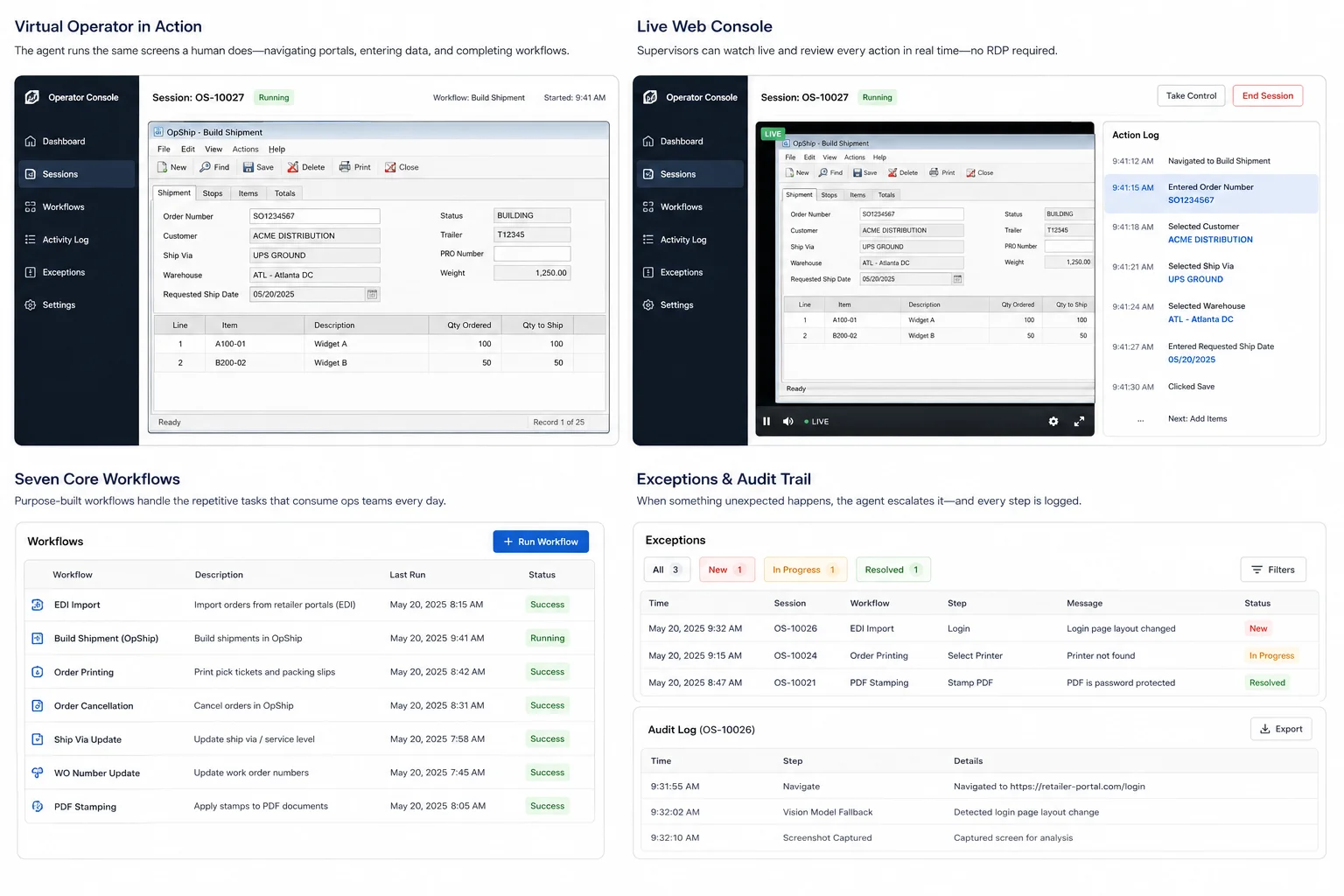
Even after Amazon confirms, the work isn't done. The legacy ERP and OpShip have to be updated, and those systems don't have APIs. Historically someone just clicked through them by hand. The virtual operator from Case Study 01 handles the close-out clicks (pre-tendering finalization), with supervision available through the Operator Console. The chain runs the same way overnight as it does during the day.

Technical detail (for the engineers in the room)
  • Email worker · classifier watches the operations mailbox, sorts messages by what they actually are, and dispatches the Amazon-routing extractor when it sees one
  • Pre-tendering manager groups orders, counts cartons, runs validation, and shapes the SP-API payload before anything goes out
  • Amazon SP-API · LWA OAuth submits the shipment and quietly manages token acquisition and refresh in the background
  • Polling worker keeps checking Amazon's transaction-status endpoint until the submission terminates one way or the other
  • Virtual operator handles the legacy-system close-out clicks at the end of the chain, with supervision available through the Operator Console

Running Amazon volume that keeps getting more demanding?

Book a free intro call. We'll walk through where your chargebacks are coming from today, and what an always-on submission chain would mean for the Amazon team.

Book an intro call
(407) 349-3633