Leak 04 · Customer portals

~2 hours per operator per day, reclaimed from customer portal work.

A Chrome extension that runs inside the customer portals your team already uses. It highlights the POs that match active shipments, fills in form fields, and drops your shipment data into a side panel so nobody has to alt-tab to find it.

The Problem

Operations staff spend a big part of every day inside ShipIQ and Amazon's portals, copying and pasting data their own system already knows.

The Result

The extension drops your own data into the portal pages, so the operator can see it without flipping back and forth.

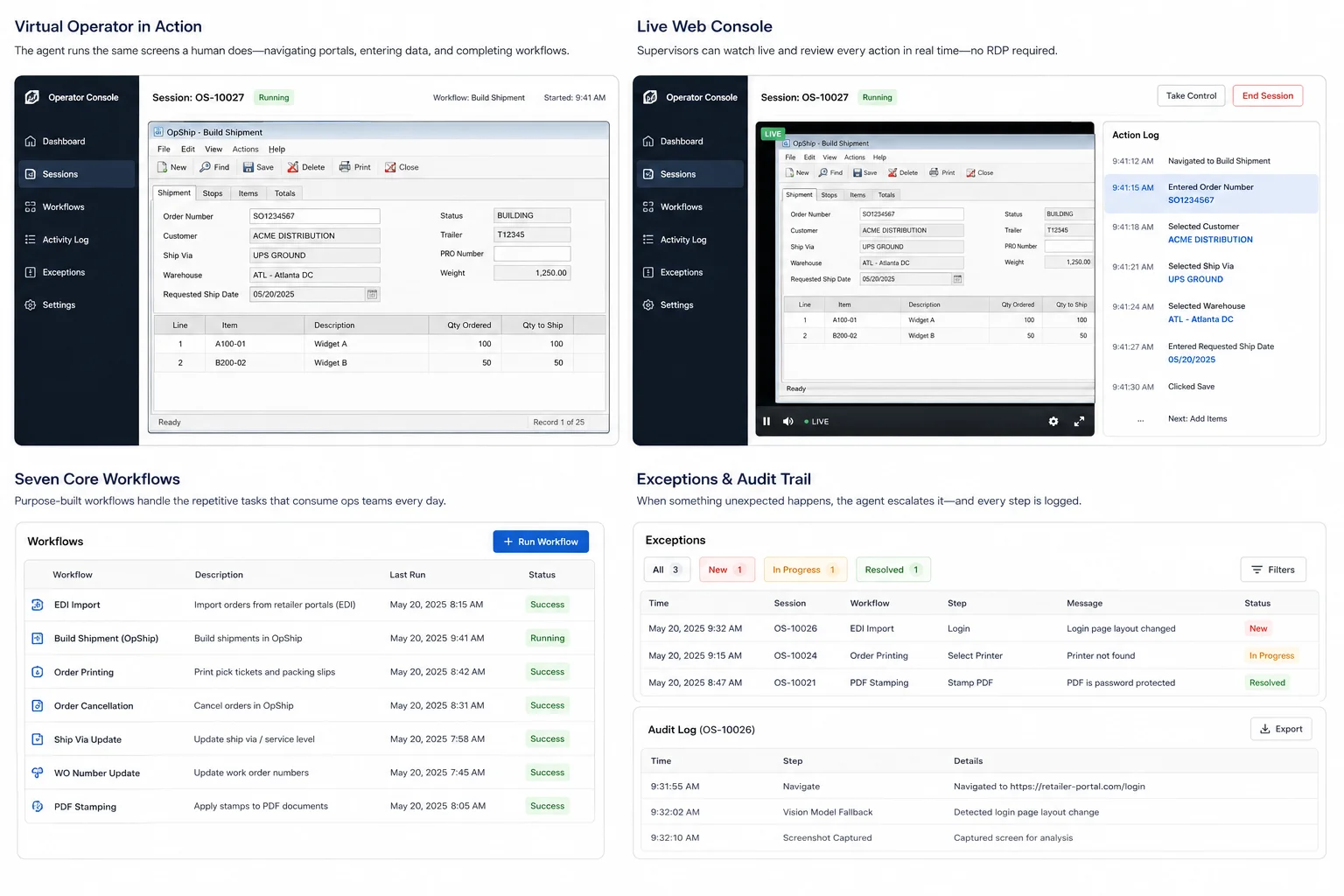
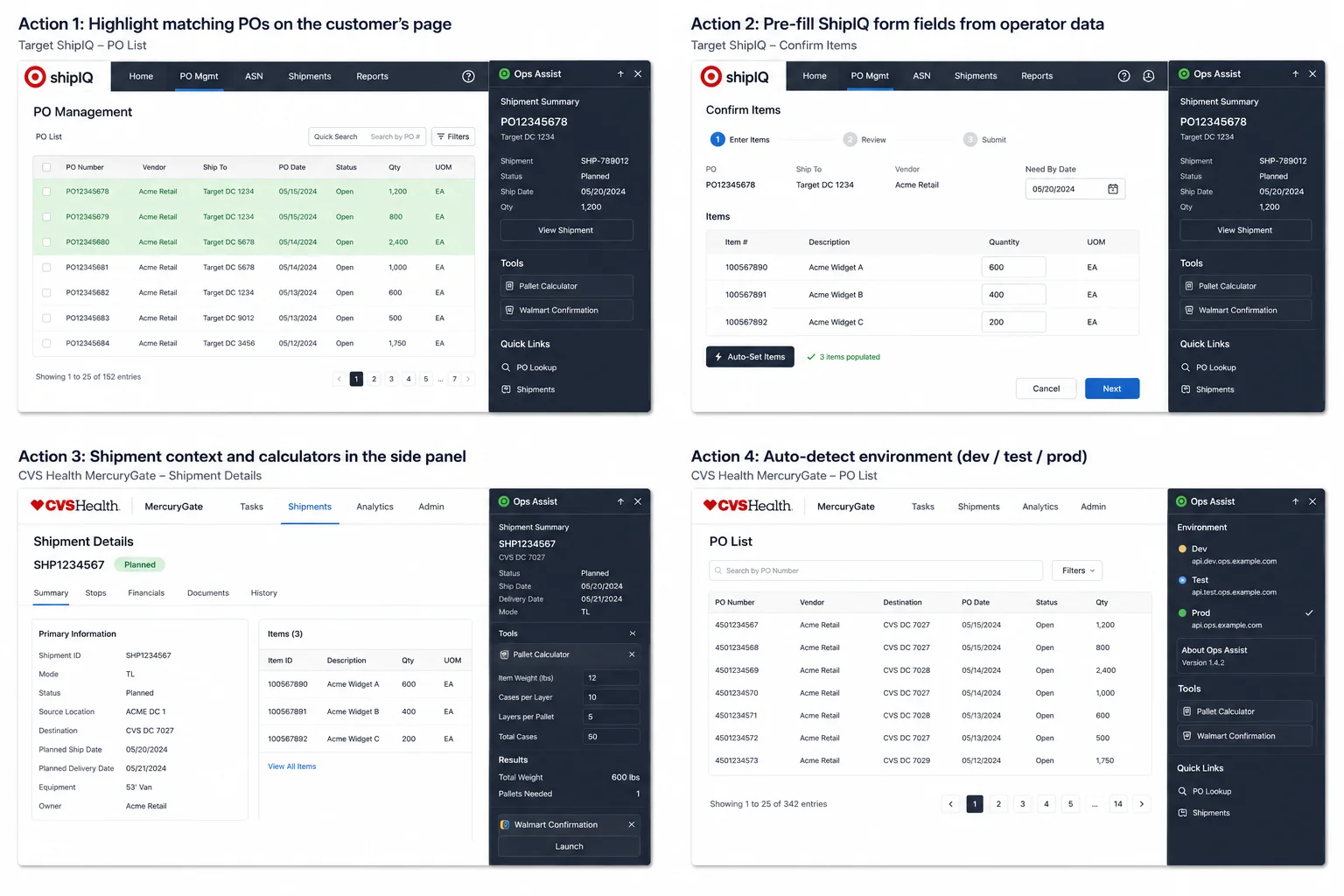
Chrome extension active inside ShipIQ and Amazon Vendor Central, highlighting matching POs and showing shipment data in a docked side panel
  • Runs inside the customer portals the team is in every day: ShipIQ (Target / partnersonline), Amazon Vendor Central, and Amazon Seller Central.
  • Highlights POs on the portal page that match active shipments, and auto-fills ShipIQ form fields from the operator's own data.
  • A side panel carries shipment context and a couple of calculators (pallet calc, Walmart confirmation) right inside the browser.
Results
3 retailer portals, one signed extension
~2 hrs/operator/day reclaimed
~0 transcription errors on auto-filled fields
  • Real hours back per operator-shift. The small frictions of copy-paste and PO-lookup add up over a day.
  • Fewer transcription errors, because the auto-fill takes out the step where most errors were getting introduced.

Your team isn't in your system. They're in your customer's.

Walk into a 3PL's operations room and a lot of the day, the team isn't in your WMS or TMS or ERP. They're in your customers' portals. ShipIQ for Target. Vendor Central for Amazon. Seller Central for the marketplace side. Those portals are the gates the work has to pass through, and they were built for the customer, not for you.

So operators end up with two screens open most of the day. The customer's portal is asking them to pick a PO, type a date, set a quantity, click submit. The other screen — your own system — already knows the answers. The operator copy-pastes, alt-tabs, mistypes a digit, starts over. Hundreds of times a day across the floor. None of it looks like a problem you can take to leadership; it's a lot of small frictions adding up to real hours and real errors over a week.
A browser extension that brings your data into your customer's portal.

It's a Chrome extension that runs inside the customer portals the team is already using every day. It reads what's on the page, looks up the matching POs and shipments in your own system, and shows that data right there in the portal. The team stops alt-tabbing.

Four pieces that took the friction tax off the portal day.

Step 01

Highlight matching POs on the customer's page

An operator lands on a ShipIQ or Amazon page with a long list of POs and has to find the ones that match their active shipments. Until now that meant scrolling, Ctrl+F, and gut feel. Content scripts read the POs on the page, ask the operations backend which ones match active shipments, and visually highlight those rows. "Where am I in this list?" becomes a glance instead of a scroll.

Step 02

Pre-fill ShipIQ form fields from operator data

ShipIQ asks the operator to type in fields the operations system already knows: quantities, item identifiers, dates. An auto-fill module reads the form, matches it against the operator's shipment data, and populates the fields. The transcription step — which is where most of the mistakes were getting introduced anyway — disappears for the common cases.

Step 03

Put shipment context and calculators in a side panel

Even with the highlight and auto-fill, operators occasionally need to look up shipment details, run a pallet calculation, or fill out a Walmart confirmation form. The extension carries a side panel with shipment status tracking, a pallet calculator UI, and a Walmart-confirmation calculator (backed by an Excel sheet under the hood). The supplementary tools live right next to the portal instead of in some other window the operator has to hunt down.

Step 04

Auto-detect dev, test, or prod so the team can switch back-ends without reinstalling

Operations staff, QA, and developers all need the same extension pointing at different back-ends at different times. Forcing each group to install a different build is fragile. An environment manager inside the extension auto-detects which back-end is reachable and routes API calls accordingly; users can also flip environments manually from the side panel. One signed extension, deployed through Group Policy, works for everyone.

Technical detail (for the engineers in the room)
  • Chrome MV3 · Service Worker runs as the background script, handling API calls to the operations backend and caching responses so the page-side scripts stay snappy
  • ShipIQ content scripts highlight matching POs on the portal page and auto-fill the form fields from the operator's own shipment data
  • Amazon content scripts cover Vendor Central and Seller Central, doing the same kind of highlighting for POs that match active shipments
  • Environment manager figures out which back-end is reachable (dev, test, or prod) and routes API calls accordingly
  • Chrome side panel carries shipment status tracking, a pallet calculator UI, and the Walmart-confirmation calculator

Watching your team live in customer portals all day?

Book a free intro call. Tell us which portals are eating up the most time (ShipIQ, Vendor Central, Seller Central, Walmart, Target) and we'll show you what a targeted browser extension could take off the day.

Book an intro call
(407) 349-3633